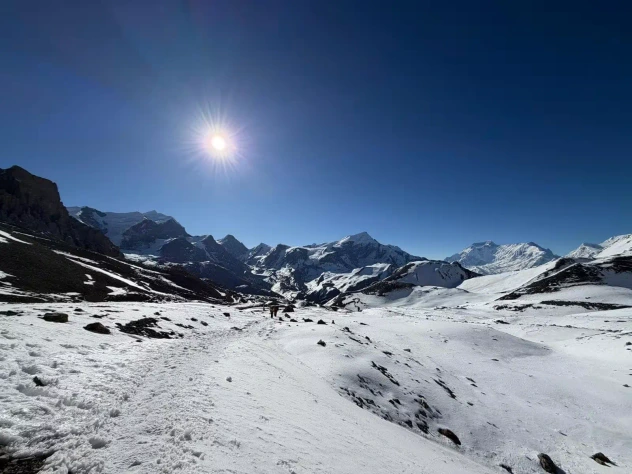
High in the Annapurna Himalayas, where the air thins and the mountains touch the sky, lies a lake that has inspired legends for millennia. Tilicho Lake, sitting at 4,919 meters (16,138 feet), is not just one of the highest lakes in the world. It is a place where mythology becomes geography, where faith meets adventure, and where every visitor leaves transformed.
For Hindus, this is no ordinary lake. It is the sacred abode of Kakbhusundi, the immortal crow sage who witnessed the Ramayana unfold. For trekkers, it is a challenging detour off the classic Annapurna Circuit that rewards with unparalleled views of the Himalayas. For pilgrims, it is a destination of deep spiritual significance, visited by thousands during the sacred month of August.
In this comprehensive guide, we will explore the rich religious significance of Tilicho Lake, the legendary story of Kakbhusundi and his connection to Garuda and the Ramayana, what you need to pack for this high-altitude trek, how long it takes, and a detailed itinerary starting from Chame. Whether you come for faith or for adventure or both, Tilicho Lake awaits.
The Sacred Legend of Kakbhusundi
According to Hindu mythology, Tilicho Lake is the eternal home of Kakbhusundi; a unique and fascinating figure. Kakbhusundi is a crow who was cursed and blessed into immortality. Unlike any other being, he possesses the rare gift of existing simultaneously in all three states of consciousness: waking, dreaming, and deep sleep.
The legend says that Kakbhusundi was originally a Brahmin named Bhushundi who was a devoted disciple of Lord Rama. Due to a curse from Sage Lomasa, he was transformed into a crow. However, Lord Rama, pleased with his unwavering devotion, blessed him with immortality and the ability to witness the entire Ramayana, not once, but countless times across different cosmic cycles.
It is believed that Kakbhusundi resides at Tilicho Lake to this day, meditating and awaiting the next incarnation of Lord Rama. Devotees believe that bathing in the lake's icy waters can cleanse one of sins and bring blessings from the immortal crow sage. Some pilgrims even report seeing a giant crow near the lake, a sign that Kakbhusundi is present.
The Immortal Crow's Blessing: Pilgrims believe that Kakbhusundi grants three wishes to those who reach Tilicho Lake with pure hearts. One for oneself, one for family, and one for all living beings.
The Ramayana Connection & Garuda
The story of Kakbhusundi is deeply intertwined with the Ramayana. In the Yoga Vasistha, an ancient philosophical text, Kakbhusundi narrates the entire Ramayana to Sage Vasistha from his unique perspective, having witnessed it unfold across multiple cosmic ages.
What makes this particularly fascinating is Kakbhusundi's relationship with Garuda, the divine eagle and mount of Lord Vishnu. According to legend, Garuda once tried to eat Kakbhusundi the crow, not recognizing his divine nature. A great debate ensued between the two birds about who was greater; Lord Vishnu (Garuda's master) or Lord Rama (Kakbhusundi's master).
The debate was resolved when both realized that Vishnu and Rama are manifestations of the same divine consciousness. Garuda and Kakbhusundi became friends, and it is said that they both visit Tilicho Lake, Garuda from time to time, and Kakbhusundi as his permanent resident. Some local traditions hold that the lake's name "Tilicho" derives from "Til" (sesame) and "Cho" (lake in Tibetan), referring to the sesame seeds offered as prayers at the site.
Other Religious Significances
Beyond the Kakbhusundi legend, Tilicho Lake holds several other layers of spiritual importance:
Sacred to Both Hindus and Buddhists
While primarily a Hindu pilgrimage site, local Tibetan Buddhists also revere the lake, believing it to be connected to the sacred Manasarovar Lake in Tibet.
The August Pilgrimage
Every year during the full moon of Shrawan (July-August), hundreds of pilgrims make the challenging journey to offer prayers and take a ritual dip in the freezing waters.
Shiva's Meditation
Some traditions hold that Lord Shiva meditated near this lake after consuming the poison during the Samudra Manthan (churning of the ocean).
Connection to Muktinath
The lake is spiritually linked to the nearby Muktinath Temple, one of the most sacred Vishnu temples in Hinduism. Many pilgrims visit both sites on the same journey.
Trek Overview & Duration
The trek to Tilicho Lake is a challenging high-altitude journey that requires good physical fitness and proper acclimatization. The lake sits at 4,919 meters, and the trail reaches its highest point near the Tilicho Base Camp at around 5,200 meters.
Two Trek Options:
This option takes you to Tilicho Lake and back, either returning to Chame or continuing to Jomsom. Duration: 7-10 days depending on starting point and pace. Suitable for those who want to focus specifically on the lake without crossing the challenging Thorong La pass.
This combines the Tilicho Lake detour with the full Annapurna Circuit, including the famous Thorong La pass at 5,416 meters. Duration: 11-12 days total. This is the classic route for adventure seekers wanting both the lake and the pass.
Important Note on Acclimatization
The trail to Tilicho Lake is at very high altitude. Proper acclimatization is essential. Never rush the journey. The side trail from Khangsar to Tilicho Base Camp involves a steep climb along a narrow, exposed path that can be dangerous in bad weather. Always check conditions before proceeding.
Detailed Itinerary (Starting from Chame)
This itinerary assumes you are starting your trek from Chame, which is already a 6-8 hour drive from Kathmandu or Pokhara. Walking begins at Chame. This route covers Tilicho Lake and continues over Thorong La to complete the Annapurna Circuit.
Drive to Chame (2,670m)
Scenic drive from Kathmandu or Pokhara to the starting point.
Chame to Pisang (3,200m)
Easy walk through pine forests with views of Paungda Danda. 5-6 hours.
Pisang to Manang (3,540m)
Gradual climb through Upper Pisang with Annapurna II views. 5-6 hours.
Acclimatization in Manang
Rest day. Optional hike to Gangapurna Lake or Ice Lake.
Manang to Shree Kharka (4,050m)
Trek towards Tilicho. Steady climb with valley views. 5-6 hours.
Shree Kharka to Tilicho Base Camp (4,150m)
Shorter day to save energy. Pass through landslide section. 4-5 hours.
Tilicho Lake (4,919m) & return to Shree Kharka
Early morning climb to the sacred lake. Visit the holy site, return. 8-9 hours.
Shree Kharka to Yak Kharka (4,050m)
Return through Khangsar to Yak Kharka. 6-7 hours.
Yak Kharka to Thorong Phedi (4,600m)
Short day to prepare for the pass. 3-4 hours.
Thorong La (5,416m) to Muktinath (3,800m)
Highest point! Cross the pass and descend to Muktinath. 7-8 hours.
Muktinath to Pokhara
Visit Muktinath Temple, then return to Pokhara via scenic road.
Complete Packing List for Tilicho Lake
Clothing
- Down jacket (-20°C rated)
- Fleece jacket and pants
- Waterproof shell jacket
- Thermal base layers (2 sets)
- Trekking pants (2 pairs)
- Warm hat, sun hat, buff
- Insulated gloves + liner gloves
- Wool hiking socks (4-5 pairs)
Gear & Essentials
- Sturdy trekking boots (broken in, waterproof)
- 35-45L daypack
- Sleeping bag (-15°C comfort)
- Trekking poles (essential)
- Headlamp + spare batteries
- Sunglasses (UV400, category 4)
- Water bottles + purification
- First aid kit + Diamox
- Sunscreen (SPF 50+) and lip balm
- Portable charger/power bank
Special Note for Tilicho: The trail from Khangsar to Tilicho Base Camp is known for frequent landslides. Bring a helmet if possible, and always check with locals about trail conditions. Trekking poles are absolutely essential for stability.
Best Time to Visit Tilicho Lake
The best times to trek to Tilicho Lake are during the pre-monsoon (spring) and post-monsoon (autumn) seasons when the weather is most stable.
Spring (March-May)
Clear skies, blooming rhododendrons, moderate temperatures. One of the best times for the trek.
Autumn (September-November)
Crystal clear mountain views, stable weather, festivals along the route. Peak season.
Winter (December-February)
Extremely cold at high altitudes. The lake often freezes. Not recommended unless you have winter expedition experience.
Monsoon (June-August)
High risk of landslides on the Khangsar-Tilicho section. The August pilgrimage still happens but is extremely challenging and dangerous.
A Journey of Faith & Adventure
Tilicho Lake is more than a trekking destination. It is a place where the boundaries between mythology and geography dissolve. Whether you come seeking the blessing of Kakbhusundi, the challenge of the highest lake, or simply the profound beauty of the Himalayas, this journey will leave an indelible mark on your soul.
The trail is challenging. Perhaps one of the most mentally and physically demanding in the Annapurna region. The landslide section between Khangsar and Tilicho Base Camp demands respect and caution. The altitude is unforgiving. But those who make it are rewarded with something that no photograph can capture.
As you stand at the shores of Tilicho Lake, at 4,919 meters, with the sacred waters reflecting the sky and the mountains standing guard, you will understand why Kakbhusundi; the immortal crow chose this place as his home. And perhaps, for a moment, you will feel immortal too.