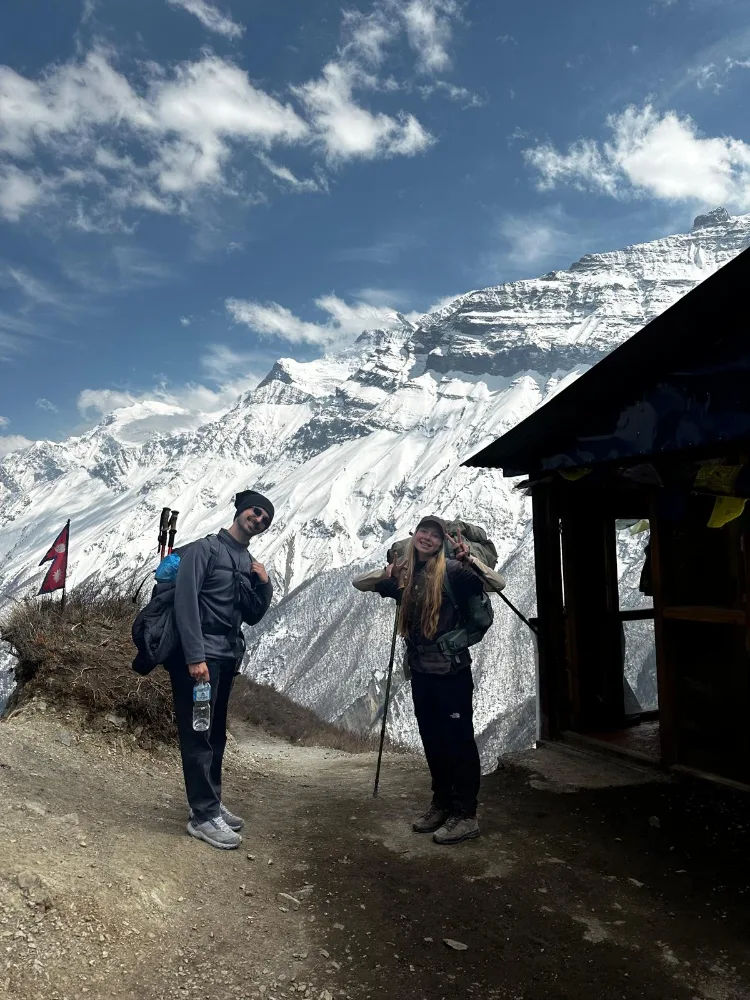
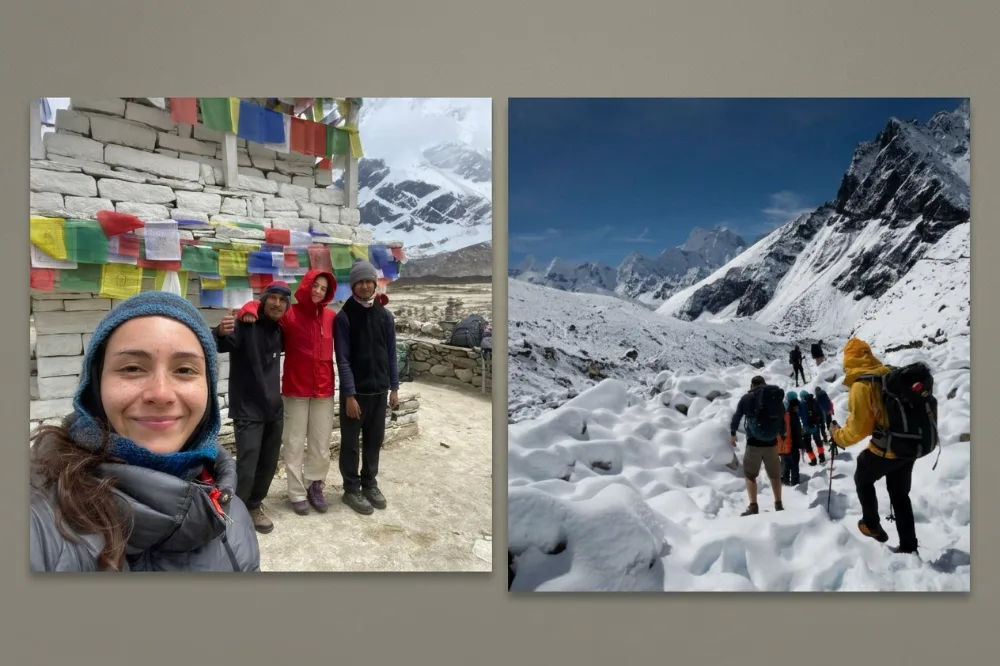
The Annapurna Circuit isn't a single climb. It's a two-week accumulation of fatigue, altitude, and terrain that tests different parts of your body on different days.
You'll walk five to eight hours a day, often carrying a pack, on trails that shift from subtropical jungle to barren high-altitude scree. You'll gain altitude gradually, which is good for acclimatization but means the fatigue builds quietly. By the time you reach Manang, you've already been walking for a week.
Then the trek asks for two specific efforts:
Tilicho Lake and the 22 Ghumti
The side trip to Tilicho Lake sits at 4,919 meters. The final push involves twenty-two switchbacks, the baais ghumti, that climb steeply through high terrain. This isn't a technical climb, but it's a sustained, steep grind at an altitude where your body is already working harder than it realizes. Many trekkers consider it the most physically demanding part of the final lake ascent because of its steep gradient, repetitive turns, and high elevation.
Thorong La and the descent
The pass itself is non-technical. The climb from Thorong Phedi or High Camp takes four to five hours from Phedi, or two and a half to three from High Camp. The summit is cold, windy, and not a place to linger. But the real test is what comes next: three to five hours of descent to Muktinath, dropping about 1,600 meters through loose scree and rocky trails. Trekkers who've done it consistently say the descent, not the ascent, is the part that surprises them. One guide puts it bluntly: "This section destroys your knees if you do not use trekking poles."
The Altitude Truth: Fitness Doesn't Protect You
Here's the part most training guides bury or skip entirely.
High physical fitness and younger age do not protect against altitude illness. This is not a motivational slogan. It's a medical fact. You can be a marathon runner and still get acute mountain sickness (AMS) at 4,000 meters if you ascend too fast. Heavy physical exertion actually increases risk regardless of baseline fitness.
The Annapurna Circuit takes you into what medical literature calls "very high altitude," 3,500 to 5,500 meters. At this level, the single most critical modifiable risk factor for altitude illness is rate of ascent. Not fitness. Not age. Not how many squats you can do. How fast you climb.
The safe ascent rate above 3,000 meters is a sleeping altitude gain of 300 to 500 meters per 24-hour period. Rapid ascent, more than 500 meters between consecutive nights above 3,000 meters, markedly increases risk. The Annapurna Circuit's traditional route is designed around this principle, which is why the rest day in Manang exists.
But here's what this means for your training: you cannot train for altitude at sea level. What you can do is build the cardiovascular base that lets you move efficiently when oxygen is scarce, and then respect the acclimatization schedule on the trek itself. The trekkers who get into trouble on Thorong La are disproportionately the ones who rushed Manang or ignored early symptoms.
If you've been to 4,000 or 5,000 meters before and felt fine, that's useful information, but it's not a guarantee. Altitude affects everyone differently, and past performance at altitude is not a reliable predictor of future performance. Treat every ascent as if it's your first.
The Training Timeline: 12 to 16 Weeks, Not 4
If you're starting from a reasonable base of fitness, you can walk for a few hours without collapsing, give yourself 12 to 16 weeks of structured preparation. If you're starting from zero, stretch it to four to six months.
The mistake most people make is cramming. A rushed four-week plan builds fatigue, not fitness, and leaves you arriving in Nepal already tired.
Phase 1: Base (Weeks 1 to 4)
The goal here is simple: get your body used to moving consistently.
Three or four cardio sessions a week, 30 to 45 minutes each. Brisk walking on incline, stair climbing, cycling, or running, whatever you'll actually do. Add two strength sessions focused on legs and core: squats, lunges, step-ups, planks.
One longer walk on the weekend, building from one hour to two. Wear the boots you'll take to Nepal. This is not optional. New boots at altitude cause blisters that turn every step into punishment.
Phase 2: Build (Weeks 5 to 9)
Now you add load and elevation.
Cardio stays at three or four sessions, but one becomes hill repeats or stair intervals, eight to ten rounds of hard climbing followed by recovery. Strength work continues twice a week, but now with a pack. Start at five kilograms and build.
The weekend hike becomes the anchor of your training. Four to five hours with a loaded pack, ideally on hills or uneven terrain. This is where you learn how your body behaves after hour three, and where you test your socks, your boots, and your snacks.
Phase 3: Peak (Weeks 10 to 14)
This is where you simulate the trek itself.
One full-day hike of six to seven hours with a five to six-kilogram pack. Then, crucially, a second hike the next day. Back-to-back efforts teach your body what consecutive trekking days feel like, and they're the closest you'll get to the fatigue of the circuit without being on it.
Cardio and strength continue, but the long hikes matter most now.
Phase 4: Taper (Weeks 15 to 16)
Cut your volume by about 40 percent. Sleep more. Do light walking and mobility work. The final week before you fly, do almost nothing intense.
You do not get fitter in the last week. You only get tired. Arrive in Kathmandu with fresh legs.
Training Specifically for the 22 Ghumti
The 22 Ghumti isn't technically difficult. It's a series of approximately twenty-two switchbacks that zigzag up a steep mountainside on high, rocky terrain. What makes it hard is the altitude and the fact that you're asking your legs to climb steeply when they're already fatigued from days of trekking.
To prepare:
Train on stairs and steep inclines. Hill repeats and stair intervals are the closest gym equivalent to switchback climbing. Build up to ten rounds of sustained climbing with short recovery.
Practice pacing. The temptation on a steep section is to push hard. At altitude, that's a mistake. Train yourself to climb slowly and steadily, breathing deliberately, stopping for brief rests before you're gasping. The trekkers who struggle on the Ghumti are often the ones who went out too fast.
Do your long training hikes on the hilliest terrain you can find. If you live somewhere flat, use a treadmill on a steep incline or find a parking garage and walk up it repeatedly. It's tedious. It's also effective.
One more thing: completing the 22 switchbacks does not mean you have reached the lake. There's still trail ahead. Train for the full effort, not just the famous section.
Training for Thorong La: The Pass Itself
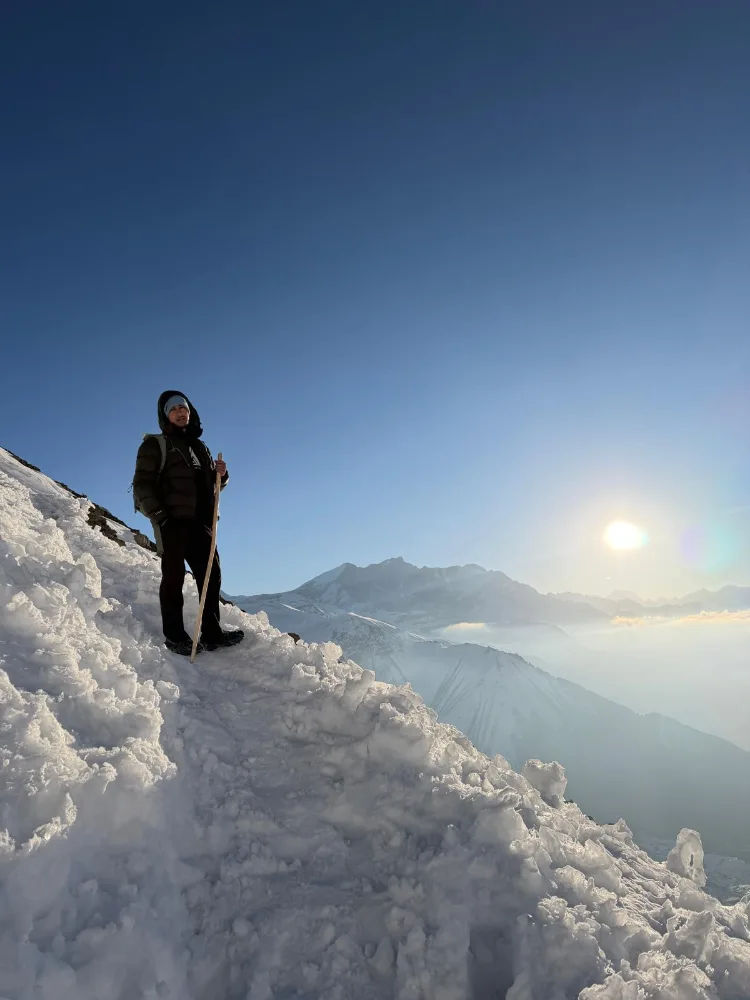
The pass is a long day, not a technical climb. Most trekkers leave High Camp around 4 a.m., reach the top in two and a half to three hours, and then face the descent. The altitude is the main challenge. At 5,416 meters, every step costs more than it should.
You can't train for altitude at sea level. What you can do is build the cardiovascular base that lets you move efficiently when oxygen is scarce, and then acclimatize properly on the trek itself.
For training:
Long, steady cardio sessions build the aerobic engine you'll rely on when the air is thin. Aim for 45 to 60 minutes at a moderate effort, three times a week.
Practice hiking in the cold and dark. Most pass attempts start before dawn, in freezing temperatures. If you've never walked by headlamp in the cold, the first time shouldn't be at 4,500 meters. Do a few early morning training hikes in winter gear to test your layers and your headlamp.
Train your appetite. Appetite drops at altitude, but you still need fuel. Practice eating snacks while walking during your long training hikes, not waiting until you're hungry, but fueling on a schedule. Find the bars, nuts, and dried fruit that your stomach tolerates during exertion, and bring those.
The Descent: The Part Nobody Trains For
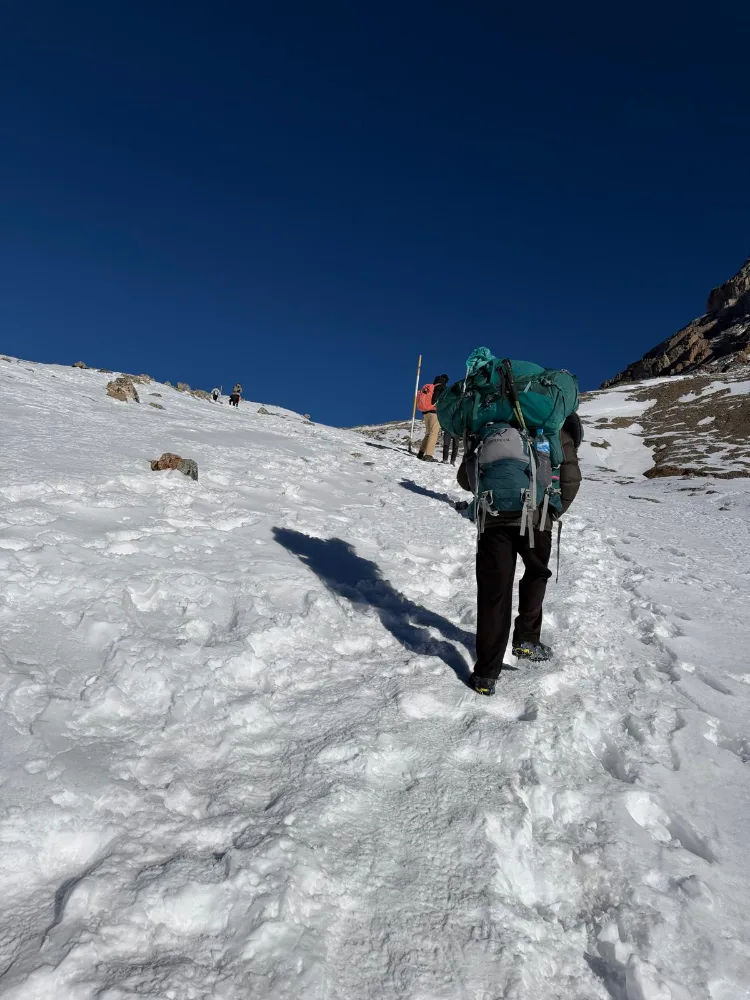
Here's the honest truth about Thorong La: reaching the prayer flags at the top is not the finish line. The descent to Muktinath is three to five hours of steep, loose, rocky trail, and it's where tired legs and unprepared knees get hurt.
Trekkers who've done the crossing consistently say the descent is harder than they expected. The phrase "knee-jarring" appears in guidebooks for a reason. Your quads are already fatigued from the climb, your concentration is fading because you think the hard part is over, and the trail keeps going down.
To prepare:
Train eccentric leg strength. Eccentric exercises, the "lowering" phase of a movement, build the muscle control that protects your knees on descents. Slow, controlled squats where you lower yourself over three seconds and stand up normally. Step-downs from a box, lowering slowly. These aren't glamorous, but they're the closest thing to descent-specific training you can do in a gym.
Use trekking poles from day one of training. Not just on the trek. Learn to use them properly, so they become automatic. On the descent from Thorong La, poles aren't optional, they're what keeps you upright when your legs are done.
Practice downhill hiking on tired legs. After your long training hikes, find a hill and walk down it. Slowly. Controlled. This teaches your body to descend when it's already fatigued, which is exactly what the Muktinath descent demands.
Strengthen your core. A strong core stabilizes you on uneven ground and takes some of the load off your knees. Planks, dead bugs, and back extensions should be part of your weekly routine.
The Things Training Can't Fix (But Preparation Can)
Fitness is only part of the equation. Three other factors matter just as much on the Annapurna Circuit, and none of them can be trained in a gym.
Acclimatization discipline
You can be the fittest person on the trail and still get altitude sickness if you ascend too fast. The Annapurna Circuit is designed to acclimatize gradually, you start low and climb slowly. But the critical factor is the rest day in Manang. Do not skip it. Use it. Take a short side hike to Gangapurna Lake or a nearby viewpoint, then rest. The trekkers who get into trouble on Thorong La are disproportionately the ones who rushed Manang.
Know the symptoms of acute mountain sickness: headache, nausea, dizziness, loss of appetite, poor sleep. If they appear, do not ascend. Tell your guide. The pass will still be there tomorrow.
And remember: high fitness does not protect you. If anything, fit trekkers are sometimes more at risk because they push harder and ignore early warning signs. The mountain doesn't care how many miles you run at home.
Boots, broken in properly
This sounds trivial. It isn't. Blisters at altitude are not just uncomfortable, they change how you walk, which strains your knees and hips, and they can become infected in a place where medical care is limited. Wear your trekking boots for every long training hike. If they cause hot spots, fix them now, not on the trail.
Mental preparation
Guides will tell you that people rarely turn back because of pure physical fatigue. They turn back because of the accumulated weight of cold mornings, basic teahouse rooms, and the monotony of walking for days. You can prepare for this, at least a little. Practice getting up early in the weeks before you go. Do a few training hikes in bad weather, on purpose. Learn to accept that some days will be hard, and that the hard days are part of the experience, not a sign that something is wrong.
A Sample Training Week (Build Phase)
Here's a weekly training template you can adapt to your schedule:
| Day | Session |
|---|---|
| Monday | Cardio: 45 min incline walking or cycling |
| Tuesday | Strength: legs and core, bodyweight or light weights |
| Wednesday | Hill repeats or stair intervals: 8 to 10 rounds |
| Thursday | Strength: legs and core with 5 kg pack |
| Friday | Rest or gentle mobility |
| Saturday | Long hike: 4 to 5 hours with 4 to 5 kg pack, hilly terrain |
| Sunday | Easy recovery walk or rest |
This is a template, not a rule. Swap days to fit your life. The principles are consistency, one long effort per week, and enough rest to recover.
The Bottom Line
The Annapurna Circuit doesn't require you to be an athlete. It requires you to be prepared for three specific things: a steep, high climb up the 22 Ghumti at 4,919 meters, a long day at 5,416 meters over Thorong La, and a 1,600-meter descent that will test your knees and your concentration long after you think the hard part is over.
Train for those three things. Respect the altitude, even if you've been to 5,000 meters before and felt fine, because altitude doesn't care about your history. And when you're standing at Tilicho Lake, or on the pass with prayer flags snapping in the wind, or finally sitting down in a Muktinath teahouse with your legs aching and your boots off, you'll be glad you didn't cram your training into four weeks.
Where We Come In
Planning your Annapurna Circuit? If you'd like help choosing an itinerary that builds in proper acclimatization, including enough time in Manang, a sensible schedule around the pass, and honest advice about what the altitude actually demands, Himkala Adventure can talk it through with you. They'll tell you what the trek requires, not just what you want to hear. Reach out via WhatsApp (+977 9745727606) or email (himkalaadventure@gmail.com) to ask about dates, fitness requirements, and what preparation actually looks like on their routes.