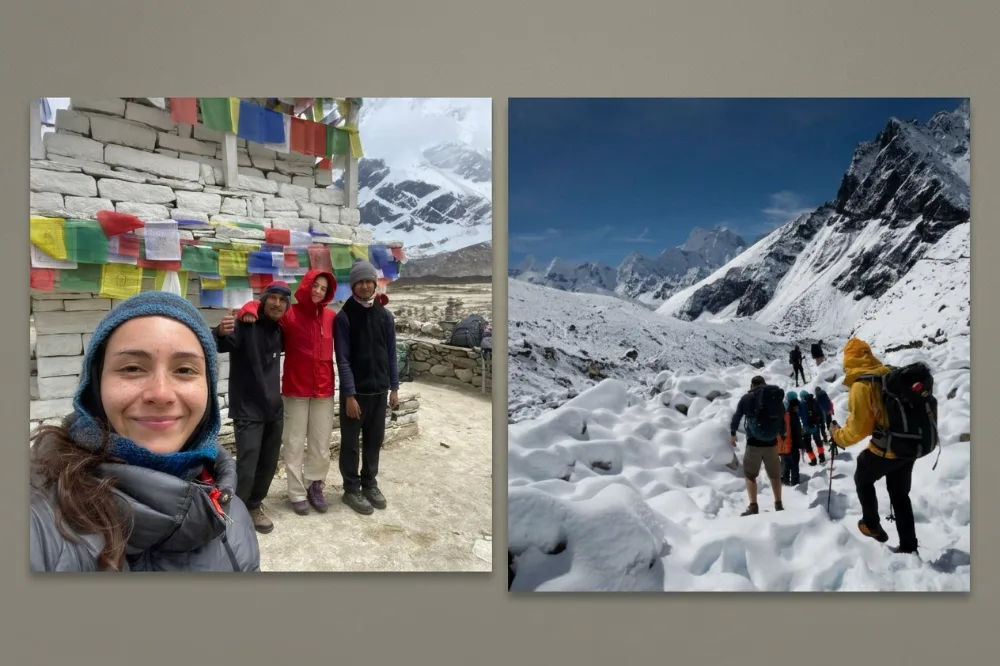
Nepal does have a real guide training system. TAAN (Trekking Agencies' Association of Nepal) runs guide training in Pokhara: 28 days, 221 participants, 24 failed. You need that certificate to get a license from the Tourism Department. Sounds rigorous, right?
But that's not where the problem is.
The problem is this: plenty of people hold licenses. What varies wildly is how they're hired and how they're treated.
Standard route: A licensed guide earns $30 to $40 per day.
Everest region: $40 to $50 per day.
Restricted areas: $50 per day.
What the daily rate excludes: This is a daily wage. Food, accommodation, and insurance are separate.
Sounds okay? Here's the catch: how many days of work does he actually get per year?
The logic at big companies is simple: take as many bookings as possible during peak season, keep nobody on payroll during the slow months. So the vast majority of guides are contract workers paid per trip, not salaried employees. The person leading you this week might have been with a different company last month, and might have nothing lined up next month.
What does that mean for you?
It means he has no structural reason to be invested in your experience beyond getting through this itinerary, collecting his daily rate, and moving on to the next booking.
The Economics of "Guided" at Scale
A large operator fills a fixed departure with 12 to 16 trekkers. That's how they make the numbers work: spread the fixed costs (transport, permits, logistics) across more paying customers.
But more trekkers per trip means:
A thinner guide-to-trekker ratio: One guide managing 14 people can't give anyone individual attention. He's counting heads, not reading faces.
The pace is set by the group, not by you: Someone's slower than everyone else? The whole group slows down. Someone's faster? They wait. Your body's rhythm is irrelevant.
The guide's job becomes crowd control, not guiding: His priority is getting everyone to the next teahouse before dark. The stories, the local knowledge, the small detours to a viewpoint most people miss, those are the first things to go when there's a schedule to keep and 14 people to move.
None of this is malice. It's math. Large groups require different logistics, and those logistics squeeze out the parts of guiding that actually make a trek memorable.
The Guide You Get Isn't Always the Guide You Booked
Here's something most trekkers don't realize until they're already on the trail: the person you meet in Kathmandu isn't necessarily the person who walks with you.
Big operators often use a tiered system. You book through a sales office. The sales office assigns an itinerary. The itinerary gets handed to a local subcontractor, sometimes a smaller agency, sometimes a freelance guide with his own connections. The guide you actually walk with may have had no contact with the company you paid.
This isn't always bad. Some subcontractors are excellent. But it means the company you booked with has limited control over, and limited responsibility for, what actually happens on the trail. If something goes wrong, you're dealing with a chain of people who each point to the next one.
What a Small Operator Actually Does Differently
This isn't an argument that big companies are evil. They serve a real market: travelers who want a fixed departure, a set price, and a group to blend into. If that's what you want, a large operator can deliver it.
But if you're hiring a guide because you want to learn something, about the mountains, the culture, the route, the people, then the structure matters.
A small operator with capped group sizes (Himkala caps at 6 to 8) works differently:
The guide is invested: The company is small enough that his reputation and the company's reputation are the same thing. He's not a name on a subcontractor list. He's the person the owner knows by name.
The pace is yours: A group of six can adjust. Someone's struggling with altitude? You slow down. Everyone's feeling strong? You take the longer route to the viewpoint. That flexibility disappears at 14 people.
The guide has room to actually guide: He can tell you what you're looking at, why the trail turns here, what happened in that village during the war. He's not counting heads.
The Honest Bottom Line
Big companies don't fail to guide you because they're lazy or dishonest. They fail because scale changes what "guided" means. At 14 trekkers per trip, with contract guides paid per day and itineraries locked months in advance, the human part of guiding, the attention, the flexibility, the local knowledge, gets squeezed out by the logistics.
If you want a guide who knows your name, notices your knee, and can change the plan when the weather turns, you need to book with someone small enough to care.
Planning a trek in Nepal? If you want to understand what a guide actually does on the trail, and what a realistic group size looks like, Himkala Adventure can talk it through with you. They'll give you a straight answer about how they run trips, not just a sales pitch.
Reach out to ask about group sizes, guide experience, and what preparation actually looks like on their routes.
Last updated: November 2026. Group sizes, guide availability, and pricing can change, so confirm current details directly with Himkala Adventure before booking.